We would never understand a forest by studying a single …


We would never understand a forest by studying a single tree in isolation.
We would ask about the soil.
The rain.
The light.
The seasons.
The microorganisms beneath the ground. The animals moving through it. What was growing there before. What has been removed. What surrounds it now.
Yet when it comes to a woman’s health, we often do the opposite.
We isolate.
Estrogen. Progesterone. Thyroid. Cortisol. Ovulation. Gut. Mood. Fertility.
Each placed into its own little box.
But a woman is an ecology.
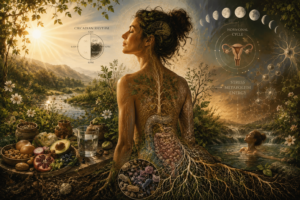
And perhaps we cannot understand her biology without understanding the environment—internal and external—in which that biology exists.
Hormones do not live in isolation
A menstrual cycle isn’t produced by the ovaries alone.
The brain communicates with the ovaries. Metabolism influences reproductive physiology. Thyroid function can affect the menstrual cycle. Stress physiology interacts with reproductive signaling. Nutritional status matters. Sleep and circadian rhythms communicate information about the outside world.
The body is conversation.
Yet healthcare and increasingly wellness culture can tempt us to hunt for one number responsible for everything.
Low progesterone? Increase it.
High cortisol? Lower it.
Insulin high? Control it.
But a biomarker is often one sentence in a much longer story.
The more interesting question can be:
Why is the body saying this?
Every ecology has conditions
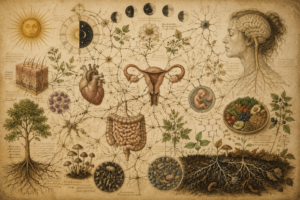
A seed contains extraordinary potential. But we don’t blame a seed for failing to grow in depleted soil.We examine the conditions. Human biology is obviously more complex, but the metaphor matters.
A woman’s physiology is continually encountering information: Is energy available? Is it day or night? Is the body under prolonged demand? Are nutrients available? What chemicals are present in the environment? What signals are arriving from other people and from the world around her?
This is particularly interesting in female fertility, because reproduction is not an isolated function. It is integrated with energy balance, endocrine signaling and the wider health of the organism.
Perhaps this is why fertility cannot be understood entirely through the reproductive organs.
The ovary belongs to the woman. And the woman belongs to an environment.
There is an ecology we cannot put on a laboratory report
Then there are the things that become uncomfortable in evidence-based conversations because they are difficult to quantify.
Grief.
Loneliness.
Pleasure.
Belonging.
A relationship with one’s body.
A relationship with nature.
Spiritual life.
Meaning.
These are not alternative hormones. They do not replace physiology, and spiritual practice is not a treatment for infertility.
But absence of a simple biomarker does not make an experience irrelevant to being human.
For centuries, healing traditions understood health through relationship: between person and food, person and season, person and community, body and mind, human being and something larger than the individual self.
Modern medicine gave us something invaluable—the ability to separate, measure and understand mechanisms with extraordinary precision.
Perhaps its limitation appears when separation becomes the only way we know how to see.

Symptoms can be part of the conversation
Modern culture teaches us to experience symptoms primarily as interruptions.
Pain interferes with work. Fatigue interferes with productivity. A menstrual cycle interferes with plans.Hunger interferes with dieting. Anxiety interferes with performance.
Naturally, symptoms sometimes require treatment, and serious symptoms should never be romanticized as spiritual messages.
But there is another possibility between ignoring symptoms and immediately silencing them:
listening to what they might tell us about the wider system.
Sometimes the answer will be pathology.
Sometimes nutrient deficiency.
Sometimes endocrine dysfunction.
Sometimes chronic under-fueling or excessive physical demand.
Sometimes the answer will not fit neatly into one category at all.
The point isn’t that the body is always wise or that every symptom has hidden meaning.
It is that context matters.

Health may be the restoration of relationship
Perhaps women’s health needs fewer wars.
War on ageing.
War on fat.
War on inflammation.
War on symptoms.
War on our own hormones.
An ecosystem cannot be bullied into balance.
It can be supported, protected, nourished and when something has genuinely gone wrong—treated.
This is where biology and something more ancient can meet. We can measure hormones and honor cycles.Use medicine and remain curious about meaning. Understand the nervous system and value touch.
Study circadian biology and experience sunrise as something beautiful.
Care about nutrition and remember that eating is also culture, pleasure and communion.
Speak about reproductive health without reducing a woman’s fertility to her ability to produce a child.
A woman is not merely the sum of her laboratory values.
She is biology in relationship with food, light, people, place, history, meaning and, perhaps, spirit.
And when we begin to see her that way, the question changes.
It is no longer only:
What is wrong with her?
It becomes:
What is happening within her ecology?
That may be a much more interesting place from which to begin.
Here’s to staying curious about our biology, our inner worlds, and all that exists between what we can measure and what we can only experience.
— Megha Kaushik